



 English
 Chinese
 Japan
Japan German
News

Reducing the rebound error of car bumper bending enhances the stability of mass production.
In modern automotive manufacturing, car bumpers are no longer simple protective components. They are complex structural parts that must meet strict requirements for safety, appearance, dimensional accuracy, and assembly compatibility. As vehicle designs become increasingly streamlined and lightweight, bumper components—often made from high-strength steel or aluminum alloys—require precise bending processes. One of the most critical challenges in bumper forming is rebound error, also known as springback. Effectively reducing rebound error plays a vital role in improving dimensional consistency and ensuring the stability of mass production.
1. Understanding Rebound Error in Car Bumper Bending
Rebound error occurs when a metal component partially returns to its original shape after the forming force is removed. During the bending process, the outer surface of the bumper profile undergoes tensile stress, while the inner surface experiences compressive stress. Once the bending force is released, the internal stresses redistribute, causing the material to elastically recover and deviate from the intended geometry.
In car bumper manufacturing, even small rebound deviations can lead to significant problems, such as:
Misalignment during vehicle assembly
Gaps or uneven surfaces affecting exterior appearance
Increased rework and scrap rates
Reduced efficiency in automated assembly lines
As mass production relies heavily on consistency and repeatability, controlling rebound error becomes a key factor in maintaining stable production quality.
2. Impact of Rebound Error on Mass Production Stability
In high-volume automotive production, bumper components must conform to tight dimensional tolerances. If rebound error is not properly controlled, variations between parts can accumulate, resulting in unstable production outcomes. This instability manifests in several ways:
Inconsistent assembly fit:Variations in curvature or angle can cause assembly interference or misalignment.
Increased quality inspection pressure:More frequent inspections and adjustments are required to compensate for dimensional deviations.
Higher production costs:Scrap, rework, and tool adjustments lead to increased operational expenses.
Production downtime:Frequent tooling corrections interrupt continuous manufacturing flow.
Therefore, minimizing rebound error is essential for achieving reliable, large-scale production with predictable output quality.
3. Material Selection and Its Influence on Rebound Control
Material properties play a crucial role in rebound behavior. High-strength steel and aluminum alloys, commonly used in car bumpers to reduce vehicle weight and improve crash performance, tend to exhibit greater elastic recovery than conventional steels.
To reduce rebound error, manufacturers must:
Select materials with stable mechanical properties and consistent yield strength
Control material thickness and temper conditions
Ensure uniform material batches for large-scale production
By standardizing material selection and minimizing property variation, rebound behavior becomes more predictable, enabling better process control.
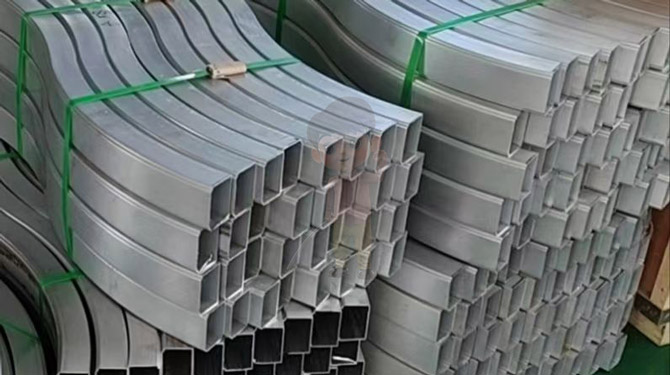
4. Advanced Bending Technologies for Rebound Reduction
Modern automotive manufacturing increasingly relies on advanced bending technologies to minimize rebound error. These include:
CNC stretch bending:Applying controlled tensile force during bending reduces elastic recovery and improves shape accuracy.
Multi-step bending processes:Gradual forming helps redistribute stress more evenly within the material.
Over-bending compensation:Intentionally bending beyond the target angle to offset rebound after force release.
These technologies allow precise control of bending parameters and significantly improve consistency across large production batches.
5. Tooling Design and Process Optimization
Tooling design is another critical factor in reducing rebound error. Optimized dies and forming tools can better support the material during bending, minimizing stress concentration and uneven deformation.
Key optimization strategies include:
Precision-machined dies with high rigidity
Adaptive tooling to accommodate material variations
Accurate control of bending speed and pressure
In mass production environments, well-designed tooling ensures long-term stability and reduces the need for frequent adjustments.
6. Digital Simulation and Data-Driven Control
The use of digital simulation and data analysis has become an effective approach to rebound control. Finite element analysis (FEA) allows engineers to predict rebound behavior before actual production, enabling proactive adjustments to tooling and process parameters.
In addition, real-time monitoring systems can collect data on bending force, displacement, and material response. This data-driven approach supports:
Continuous process optimization
Early detection of deviations
Improved repeatability in mass production
By combining simulation with real-time feedback, manufacturers can significantly enhance production stability.
7. Benefits of Reduced Rebound Error in Mass Production
When rebound error is effectively controlled, automotive manufacturers benefit in multiple ways:
Improved dimensional accuracy and product consistency
Higher assembly efficiency and reduced line stoppages
Lower scrap and rework rates
Enhanced product quality and customer satisfaction
Ultimately, reducing rebound error supports lean manufacturing principles and strengthens a manufacturer’s competitiveness in the automotive industry.
Reducing the rebound error of car bumper bending is a key technical challenge in modern automotive manufacturing. Through optimized material selection, advanced bending technologies, precise tooling design, and data-driven process control, manufacturers can significantly improve dimensional accuracy and production consistency. Effective rebound control not only enhances the stability of mass production but also contributes to cost reduction, quality improvement, and long-term manufacturing efficiency. As vehicle designs continue to evolve, rebound error management will remain a critical factor in achieving high-quality, scalable automotive production.
 LIST
LIST17
2025-12
Number of visitors:1
HOT NEWS
-
Tensile Bending Explained: How Precision Shapes Complex Metal Profiles
2026-09-16
-
Custom Aluminum Profile Stretch Bending Solutions
2026-09-01
-
Professional Metal Bending for Custom Fabrication Projects
2026-08-17
-
Aluminum Bending Technology: Processes, Applications, and Industry Advantages
2026-08-01