



 English
 Chinese
 Japan
Japan German
News

Profile Bending Techniques: Enhancing Structural Precision and Design Flexibility
Profile bending is a critical manufacturing process widely used in industries such as construction, automotive, aerospace, and industrial equipment production. It involves shaping metal or plastic profiles—such as tubes, beams, angles, and channels—into desired curves or angles without compromising their structural integrity. As modern engineering demands increasingly complex geometries and higher performance standards, advanced profile bending techniques play a vital role in achieving both structural precision and design flexibility.
Understanding Profile Bending
At its core, profile bending is the controlled deformation of a material along a specific axis to achieve a predetermined curvature. Unlike simple bending processes, profile bending often involves maintaining the cross-sectional shape of the material while applying force gradually and evenly. This requires specialized machinery, skilled operators, and precise control systems to ensure accuracy and repeatability.
Profiles can vary significantly in shape and size, including round tubes, square sections, I-beams, U-channels, and custom extrusions. Each type presents unique challenges in terms of bending behavior, stress distribution, and risk of deformation such as wrinkling, flattening, or cracking.
Common Profile Bending Techniques
Several techniques are commonly used in profile bending, each suited to different materials, shapes, and applications:
1.Roll Bending
Roll bending is one of the most widely used methods. It employs a set of rollers—typically three or four—to gradually bend the profile into a curve. This technique is ideal for producing large-radius bends and is commonly used in structural applications such as arches, frames, and railings. Roll bending offers high precision and is suitable for both thin and thick materials.
2.Rotary Draw Bending
This method uses a rotating die to bend the profile around a fixed radius. It is particularly effective for achieving tight radii and maintaining consistent cross-sections. Rotary draw bending is commonly used in industries where precision is critical, such as automotive exhaust systems and aerospace components.
3.Press Bending
Press bending involves applying force through a press machine to bend the profile at a specific point. It is suitable for simple bends and smaller production runs. While it offers flexibility in terms of setup, it may not provide the same level of consistency as other methods for complex shapes.
4.Stretch Bending
In stretch bending, the profile is stretched longitudinally while being bent over a form. This reduces the risk of wrinkling and improves surface finish. It is often used for large, smooth curves in architectural and aerospace applications.
5.Induction Bending
This advanced technique uses localized heating (via induction) to make the material more pliable during bending. It is ideal for thick-walled profiles and high-strength materials, allowing for precise bends with minimal residual stress.
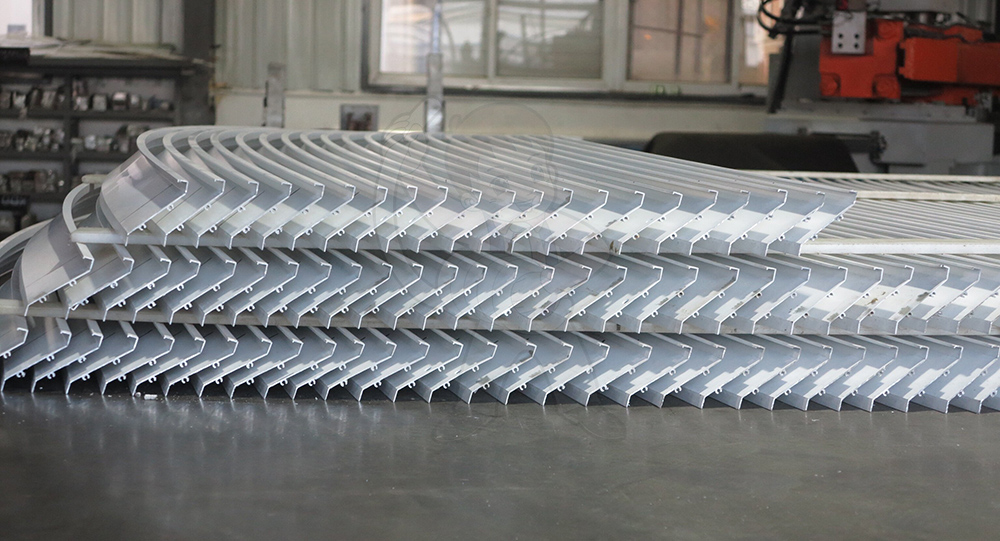
One of the key advantages of modern profile bending techniques is the ability to achieve exceptional structural precision. Computer Numerical Control (CNC) systems are now widely integrated into bending machines, enabling highly accurate control over bending angles, radii, and positioning. This reduces human error and ensures consistent results across large production batches.
Material selection also plays a crucial role in precision. Different metals—such as steel, aluminum, and stainless steel—have varying mechanical properties, including yield strength, elasticity, and ductility. Understanding these properties allows engineers to predict how a material will behave during bending and adjust parameters accordingly.
Additionally, simulation software is increasingly used to model the bending process before actual production. This helps identify potential issues such as deformation or stress concentration, allowing for adjustments that improve final product quality.
Profile bending techniques significantly expand the possibilities for designers and engineers. Complex curves, custom shapes, and innovative structures can be achieved without the need for multiple welded joints or segmented components. This not only enhances aesthetic appeal but also improves structural performance by reducing weak points.
In architecture, for example, curved steel beams and aluminum profiles are used to create visually striking facades and organic shapes. In the automotive industry, bent profiles contribute to aerodynamic designs and lightweight structures. Similarly, in furniture and product design, profile bending enables sleek, modern forms that would be difficult to achieve through traditional fabrication methods.
Moreover, the ability to customize bending processes allows manufacturers to meet specific project requirements, whether it involves unique geometries, tight tolerances, or specialized materials.
Despite its advantages, profile bending presents several challenges. Maintaining the integrity of the profile during bending is a primary concern. Issues such as wall thinning, ovalization, and surface defects can occur if the process is not properly controlled.
Tooling design is another critical factor. Custom dies, rollers, and fixtures may be required for specific profiles, increasing initial setup costs. However, these investments are often justified by improved quality and efficiency in the long run.
Operator expertise and machine calibration are also essential. Even with advanced automation, skilled technicians are needed to monitor the process, make adjustments, and ensure optimal performance.
Profile bending techniques are essential for modern manufacturing, offering a powerful combination of structural precision and design flexibility. From simple curves to complex geometries, these processes enable the creation of high-quality components that meet the demands of various industries. With ongoing advancements in technology, including CNC automation and simulation tools, profile bending continues to evolve, providing even greater accuracy, efficiency, and creative potential.
As industries push the boundaries of design and performance, mastering profile bending techniques will remain a key factor in achieving innovative and reliable engineering solutions.
 LIST
LIST17
2026-03
Number of visitors:1
HOT NEWS
-
Custom Aluminum Profile Stretch Bending Solutions
2026-09-01
-
Professional Metal Bending for Custom Fabrication Projects
2026-08-17
-
Aluminum Bending Technology: Processes, Applications, and Industry Advantages
2026-08-01
-
Window and Door Profile Bending Services: Precision Curved Aluminum Solutions for Modern Architecture
2026-07-17