



 English
 Chinese
 Japan
Japan German
News

Rotary Door Frame Bending Solutions: Achieving Smooth Curves and Structural Stability
Rotary doors are widely used in commercial buildings, hotels, airports, and high-end office entrances, where both aesthetics and functionality are critical. One of the key elements that determines the overall quality of a rotary door system is the precision of its curved frame. Rotary door frame bending is not just a simple forming process—it requires careful control of geometry, material behavior, and structural integrity to achieve smooth curves without compromising strength.
Understanding Rotary Door Frame Bending
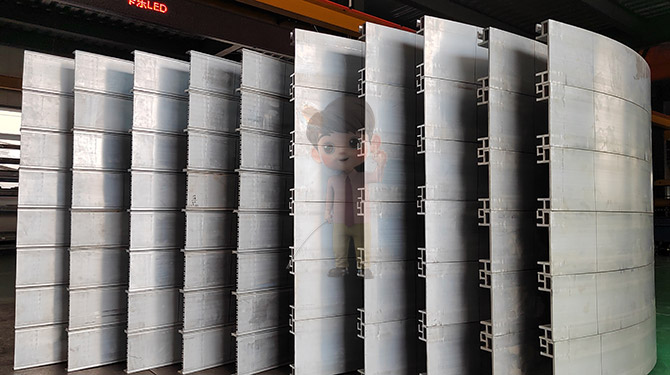
Rotary door frames are typically made from aluminum or steel profiles that must be bent into precise circular or arc shapes. These frames serve as the structural backbone of the door system, supporting glass panels, rotation mechanisms, and load-bearing components.
Unlike straight profiles, curved frames must maintain:
Consistent radius throughout the arc
Minimal deformation of the cross-section
High dimensional accuracy for seamless assembly
Any deviation can lead to installation difficulties, poor rotation performance, or long-term structural issues.
Common Materials and Their Behavior
The most commonly used materials in rotary door frame bending include aluminum alloys and stainless steel.
Aluminum profilesare lightweight, corrosion-resistant, and easier to bend, but they are more prone to surface deformation and springback.
Stainless steel profilesoffer higher strength and durability, but require greater force and more advanced equipment during bending.
Understanding the mechanical properties of each material—such as yield strength, elasticity, and ductility—is essential for selecting the appropriate bending method.
Key Bending Techniques
Several bending methods are used depending on the profile shape, material, and required radius:
1. Cold Bending
This is the most common method for aluminum profiles. It uses mechanical force to gradually form the desired curve without heating. Cold bending is efficient and cost-effective but requires precise control to avoid wrinkling or distortion.
2. Stretch Bending
In this method, the profile is stretched while being bent, which helps reduce internal stress and improves dimensional accuracy. It is especially suitable for high-precision rotary door frames.
3. Roll Bending
Roll bending machines use multiple rollers to gradually shape the profile into a curve. This method is ideal for large-radius applications and continuous arcs.
4. Hot Bending (when necessary)
For thicker or harder materials, controlled heating may be applied to improve formability. However, this method requires careful temperature management to avoid material degradation.
Controlling Deformation and Ensuring Smooth Curves
One of the biggest challenges in rotary door frame bending is maintaining a smooth, uniform curve without defects. Common issues include:
Cross-section distortion
Surface scratches or marks
Uneven curvature
Wrinkling on the inner radius
To address these challenges, manufacturers implement several strategies:
Custom-designed molds and diesthat match the profile geometry
Multi-point support systemsto distribute force evenly
Protective layers or coatingsto prevent surface damage
Gradual bending processesto reduce stress concentration
Precision equipment combined with experienced operators is key to achieving high-quality results.
Managing Springback for Accuracy
Springback—the tendency of a material to partially return to its original shape after bending—is a critical factor in achieving dimensional accuracy.
To compensate for springback:
Bending angles are slightly over-adjusted during processing
Material-specific compensation values are applied
Trial runs and measurements are used to refine parameters
Advanced manufacturers may also use simulation software to predict springback behavior and optimize the process before actual production.
Structural Stability and Load Performance
A rotary door frame must not only look smooth but also perform reliably under operational loads. Structural stability is influenced by:
Material thickness and profile design
Accuracy of the bending radius
Quality of joints and connections
Alignment during installation
Poorly bent frames can lead to misalignment, increased wear on moving parts, and reduced lifespan of the door system.
Therefore, strict quality control is essential throughout the entire process.
Quality Inspection and Finishing
After bending, frames undergo detailed inspection to ensure they meet design specifications. Common inspection methods include:
Radius and curvature measurement
Dimensional tolerance checks
Surface quality inspection
Trial assembly verification
Finishing processes such as polishing, anodizing (for aluminum), or coating are also important to enhance durability and visual appeal.
Customization and Project Requirements
Each rotary door project may have unique requirements, including different diameters, profile shapes, and architectural designs. Custom bending solutions are often necessary to meet these specifications.
Close collaboration between designers, engineers, and fabricators ensures that:
The bending process aligns with design intent
Structural requirements are met
Installation is efficient and accurate
Rotary door frame bending is a specialized fabrication process that demands a balance between precision engineering and practical manufacturing techniques. Achieving smooth curves while maintaining structural stability requires careful material selection, advanced bending methods, accurate compensation for springback, and rigorous quality control.
For architects, contractors, and manufacturers alike, investing in high-quality bending solutions is essential to ensure that rotary door systems perform reliably while delivering the desired visual impact.
 LIST
LIST30
2026-04
Number of visitors:1
HOT NEWS
-
Custom Aluminum Profile Stretch Bending Solutions
2026-09-01
-
Professional Metal Bending for Custom Fabrication Projects
2026-08-17
-
Aluminum Bending Technology: Processes, Applications, and Industry Advantages
2026-08-01
-
Window and Door Profile Bending Services: Precision Curved Aluminum Solutions for Modern Architecture
2026-07-17