



 English
 Chinese
 Japan
Japan German
News

Arc Bending of Profiles: Techniques, Precision Control, and Quality Standards
Arc bending of profiles is a critical manufacturing process used to form metal and composite sections into curved geometries for applications in construction, transportation, architecture, and industrial equipment. From aluminum window frames to steel structural members, the ability to achieve precise and repeatable curvature directly affects both functionality and aesthetics. This article explores the main bending techniques, methods of precision control, and the quality standards that define reliable arc bending operations.
1. Common Techniques for Arc Bending
The choice of bending technique depends on the profile geometry, material properties, required radius, and production volume. The most widely used methods include:
Roll Bending (Three-Roll or Four-Roll Bending):
This is the most common method for creating large-radius curves. The profile passes through a set of rollers that gradually deform it into an arc. It is suitable for long components and continuous curves, offering good surface quality with relatively low tooling cost.
Rotary Draw Bending:
Often used for tighter radii and high-precision applications, this method clamps the profile and draws it around a fixed die. It is commonly applied to tubes and hollow sections where shape retention is critical.
Stretch Bending:
The profile is stretched while being bent over a form block, reducing springback and improving dimensional accuracy. This technique is widely used in aerospace and architectural components.
Press Bending (Incremental Bending):
A press applies force at specific نقاط along the profile to gradually form the desired curve. It is flexible but may require post-processing to smooth transitions.
Each method involves trade-offs between precision, cost, production speed, and material limitations.
2. Material Considerations
Material selection plays a major role in arc bending performance. Key factors include yield strength, ductility, and work-hardening behavior:
Steel:High strength but requires greater force; risk of cracking if bend radius is too small.
Aluminum:Lightweight and formable, but prone to springback and surface marking.
Stainless Steel:Combines strength and corrosion resistance, but demands precise control and robust tooling.
Additionally, material condition (annealed vs. hardened) significantly influences bending behavior. Pre-treatment or heat treatment may be necessary to achieve optimal results.
3. Precision Control in Arc Bending
Achieving consistent curvature and tight tolerances requires careful control of multiple variables:
Springback Compensation:
Materials tend to partially return to their original shape after bending. Accurate prediction and compensation are essential, often supported by simulation software or empirical data.
Tooling Design:
Properly matched rollers, dies, and support systems help maintain cross-sectional integrity and prevent distortion such as ovalization or wrinkling.
Process Parameters:
Feed rate, pressure, roller position, and bending sequence must be calibrated based on material and profile geometry.
Measurement and Feedback:
Laser scanning, radius gauges, and digital measurement systems are used to verify curvature and adjust the process in real time.
Modern CNC-controlled machines enable high repeatability and allow operators to store and reuse optimized settings.
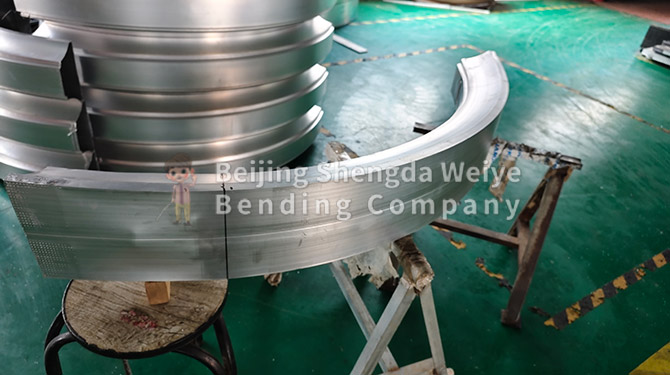
4. Common Defects and Mitigation Strategies
Arc bending can introduce several defects if not properly controlled:
Cross-section Deformation:
Especially in hollow profiles; mitigated using internal mandrels or support inserts.
Surface Cracking:
Caused by excessive तनाव or small bend radii; addressed by adjusting material condition or increasing radius.
Wrinkling or Buckling:
Occurs on the inner radius; reduced by proper الدعم and controlled pressure.
Twisting or Misalignment:
Often due to uneven force distribution; corrected through precise machine setup.
Early-stage prototyping and simulation help identify and reduce these risks.
5. Quality Standards and Inspection
Quality assurance in arc bending involves both dimensional accuracy and surface integrity:
Dimensional Tolerances:
Radius, angle, and straightness are measured against design specifications. Industry standards or client requirements define acceptable deviations.
Surface Quality:
Profiles should be free from scratches, dents, or oxidation, especially for visible architectural applications.
Structural Integrity:
For load-bearing components, non-destructive testing (NDT) methods may be used to detect internal flaws.
Documentation, traceability, and process consistency are increasingly important, particularly in regulated industries.
6. Industry Applications
Arc-bent profiles are used across multiple sectors:
Construction:Curved beams, façades, and railings
Transportation:Vehicle frames, exhaust systems, rail components
Architecture:Decorative metalwork and custom structures
Energy:Wind tower components and pipeline systems
Each application places different demands on precision, strength, and finish.
Arc bending of profiles is a sophisticated process that combines material science, mechanical engineering, and advanced manufacturing techniques. By selecting the appropriate bending method, controlling key parameters, and adhering to strict quality standards, manufacturers can produce high-performance curved components with excellent accuracy and consistency. As automation and digital simulation continue to evolve, the efficiency and precision of arc bending will only improve, enabling more complex and innovative designs across industries.
 LIST
LIST28
2026-04
Number of visitors:1
HOT NEWS
-
Custom Metal Bending Solutions for Industrial Manufacturing
2026-10-14
-
Aluminum Bending Services | Professional Aluminum Profile Bending Solutions
2026-09-30
-
Tensile Bending Explained: How Precision Shapes Complex Metal Profiles
2026-09-16
-
Custom Aluminum Profile Stretch Bending Solutions
2026-09-01