



 English
 Chinese
 Japan
Japan German
News

Profile Bending Process Explained: From Design Drawings to Finished Curved Components
Profile bending is an essential manufacturing process used to create curved metal sections for a wide range of industries, including architecture, transportation, automotive engineering, aerospace, and industrial equipment manufacturing. As modern designs increasingly incorporate curved structures and customized shapes, profile bending technology has become an effective solution for producing high-precision components while maintaining structural integrity.
Unlike conventional cutting and welding methods, profile bending transforms straight metal sections into smooth and continuous curves without compromising the original cross-sectional properties of the material. Understanding the complete bending process can help engineers, designers, and project managers make informed decisions when planning custom curved components.
Understanding Project Requirements and Technical Drawings
Every profile bending project begins with a detailed review of design requirements and engineering drawings. This stage plays a crucial role in determining whether the desired shape can be manufactured accurately and efficiently.
Technical drawings typically include important information such as:
Material specifications
Profile dimensions
Bending radius
Arc length
Tolerance requirements
Surface finish expectations
Quantity needed
Engineers carefully analyze the drawings to evaluate potential challenges, including tight bending radii, asymmetrical cross-sections, or complex three-dimensional curves.
For architectural applications, designers may provide CAD files or BIM models to ensure that bent components fit seamlessly into curtain wall systems, skylights, canopies, or decorative structures.
In industrial projects, the design review process may also consider load-bearing requirements and assembly compatibility with other components.
Early communication between customers and manufacturers helps avoid production delays and ensures that all technical details are clearly defined before fabrication begins.
Material Selection and Evaluation
The next step involves selecting the appropriate material for bending.
Profile bending can be performed on various materials, including aluminum alloys, stainless steel, carbon steel, brass, copper, and specialized industrial alloys.
Each material behaves differently during bending operations.
Aluminum is lightweight and offers excellent ductility, making it suitable for tight-radius bends and architectural applications.
Stainless steel provides high strength and corrosion resistance but generally requires greater bending forces.
Carbon steel is commonly used in structural applications where durability and load capacity are important.
Manufacturers assess several factors before processing the material, including:
Material thickness
Tensile strength
Elongation characteristics
Surface coating conditions
Existing heat treatment status
Certain profiles with thin walls or intricate geometries may require additional support tooling to prevent deformation during bending.
Material inspection at this stage also helps identify defects such as scratches, dents, or inconsistencies that could affect the final product quality.
Tooling Design and Preparation
Tooling is one of the most important aspects of profile bending.
Custom-designed dies and support fixtures help maintain the original cross-sectional shape while the profile is subjected to bending forces.
Different profile shapes require different tooling configurations.
For example, rectangular tubes, T-sections, channels, and hollow profiles each demand specialized support systems.
Experienced manufacturers often create dedicated tooling based on customer drawings and material specifications.
Advanced software programs can simulate bending behavior before production begins, allowing engineers to predict springback effects and optimize tooling dimensions.
Proper tooling design significantly reduces the risk of:
Cross-section distortion
Surface damage
Twisting
Wrinkling
Excessive springback
In high-precision industries such as aerospace and transportation, tooling accuracy directly influences component performance and assembly reliability.
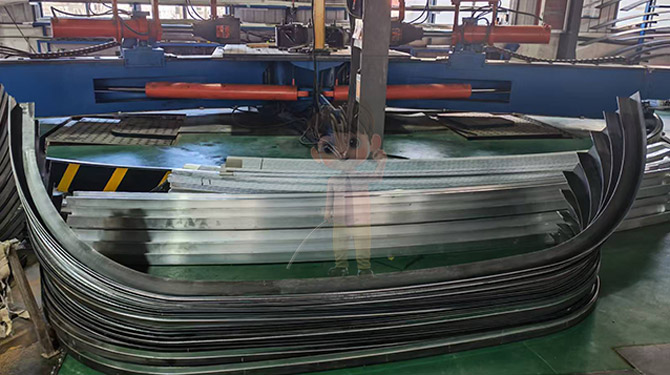
CNC Profile Bending Operations
Once materials and tooling are prepared, the actual bending process begins.
Modern profile bending facilities commonly utilize CNC-controlled bending machines to achieve consistent and repeatable results.
The bending machine applies controlled tensile forces while gradually shaping the profile around a predetermined radius.
Depending on project requirements, manufacturers may use various bending techniques, including stretch bending, roll bending, rotary draw bending, or compression bending.
Stretch bending is particularly effective for producing large-radius curves while preserving profile geometry.
Roll bending is suitable for circular and spiral shapes and is often used in structural steel fabrication.
CNC systems allow operators to input precise bending parameters such as:
Radius measurements
Arc angles
Feed speed
Tension values
Compensation factors
Automation minimizes human error and ensures uniformity when producing multiple components with identical dimensions.
For complex three-dimensional profiles, several bending operations may be performed sequentially to achieve the desired shape.
Correcting Springback and Shape Adjustments
One common challenge in profile bending is springback.
After bending forces are removed, metal materials naturally attempt to return to their original shape.
The amount of springback varies depending on material type, profile geometry, and bending radius.
Experienced technicians compensate for this effect by applying slightly greater bending angles during processing.
Trial bending samples are often produced and measured before full-scale production begins.
If deviations are detected, machine settings can be adjusted accordingly.
Manual corrections may also be necessary for highly customized projects.
Skilled operators carefully inspect the bent profile and perform minor refinements to achieve the required dimensional accuracy.
This step is particularly important for architectural components that must align perfectly with glass panels, façade systems, or adjacent structural elements.
Quality Inspection and Dimensional Verification
After bending is completed, each component undergoes a comprehensive quality inspection process.
Manufacturers use various measurement tools and technologies to verify compliance with design specifications.
Inspection methods may include:
Radius gauges
Coordinate measuring machines
Laser scanning systems
Digital angle measurement devices
Critical dimensions such as bending radius, arc length, profile straightness, and cross-sectional integrity are carefully checked.
Surface quality inspections are also conducted to identify scratches, cracks, coating damage, or other imperfections.
For projects with strict engineering standards, inspection reports may be provided to customers as part of the quality assurance documentation.
Maintaining consistent quality control procedures helps ensure that bent components meet both aesthetic and functional requirements.
Surface Treatment and Finishing
Depending on application requirements, bent profiles may undergo additional finishing processes.
Architectural aluminum profiles often receive anodizing, powder coating, or fluorocarbon painting to enhance corrosion resistance and visual appearance.
Stainless steel components may be polished or brushed to achieve decorative effects.
Protective films can also be applied to prevent scratches during transportation and installation.
In some cases, manufacturers perform assembly trials before shipment to verify compatibility with connecting elements.
Proper finishing not only improves product appearance but also extends service life, especially in outdoor environments exposed to moisture, sunlight, and temperature fluctuations.
Packaging, Transportation, and Delivery
The final stage involves packaging and logistics preparation.
Curved profiles require special handling to prevent deformation during transportation.
Manufacturers typically use custom support frames, foam padding, wooden crates, or protective wrapping materials to secure components.
Large-scale projects may involve phased deliveries according to installation schedules, helping contractors manage on-site storage and workflow more efficiently.
Timely delivery is particularly important for construction projects, where delayed materials can impact the overall project timeline.
Reliable manufacturers often coordinate closely with customers to ensure that finished products arrive safely and on schedule.
Profile bending is a highly specialized manufacturing process that combines engineering expertise, advanced machinery, and skilled craftsmanship. From reviewing technical drawings and selecting suitable materials to CNC bending, quality inspection, and final delivery, each stage contributes to producing accurate and visually appealing curved components.
As architectural designs become more innovative and industrial applications demand increasingly complex geometries, profile bending technology continues to evolve. By integrating digital design tools, automated equipment, and rigorous quality control systems, manufacturers can efficiently produce customized curved profiles that meet modern engineering standards and aesthetic expectations.
For companies seeking reliable curved metal solutions, understanding the complete profile bending process is the first step toward achieving successful project outcomes and long-term structural performance.
 LIST
LIST27
2026-06
Number of visitors:1
HOT NEWS
-
Tensile Bending Explained: How Precision Shapes Complex Metal Profiles
2026-09-16
-
Custom Aluminum Profile Stretch Bending Solutions
2026-09-01
-
Professional Metal Bending for Custom Fabrication Projects
2026-08-17
-
Aluminum Bending Technology: Processes, Applications, and Industry Advantages
2026-08-01