



 English
 Chinese
 Japan
Japan German
News

Aluminum Bending Technology: Processes, Applications, and Industry Advantages
Aluminum bending technology has become an essential metal forming process in modern manufacturing industries. With the increasing demand for lightweight, durable, and aesthetically appealing metal components, aluminum bending provides an efficient solution for creating complex shapes while maintaining material strength and structural integrity.
Aluminum is widely used because of its excellent properties, including low density, corrosion resistance, high strength-to-weight ratio, and good recyclability. However, due to its unique mechanical characteristics, aluminum requires specialized bending techniques to achieve precise shapes without cracking, deformation, or surface damage.
From architectural structures and transportation systems to industrial equipment and consumer products, aluminum bending technology plays an important role in improving product performance, reducing manufacturing costs, and expanding design possibilities.
What Is Aluminum Bending Technology?
Aluminum bending technology refers to the process of applying controlled force to aluminum profiles, sheets, or tubes to create specific curved shapes and angles. Unlike simple cutting or welding processes, bending allows manufacturers to form continuous structures with fewer joints, improving both appearance and mechanical performance.
During the bending process, manufacturers must carefully control several factors, including material thickness, alloy type, bending radius, forming speed, and temperature conditions. Proper control of these factors helps prevent common issues such as cracking, springback, surface marks, and dimensional inaccuracies.
Modern aluminum bending typically uses advanced equipment and computer-controlled systems to achieve high precision and consistent results for different industrial requirements.
Main Aluminum Bending Processes
1. Roll Bending
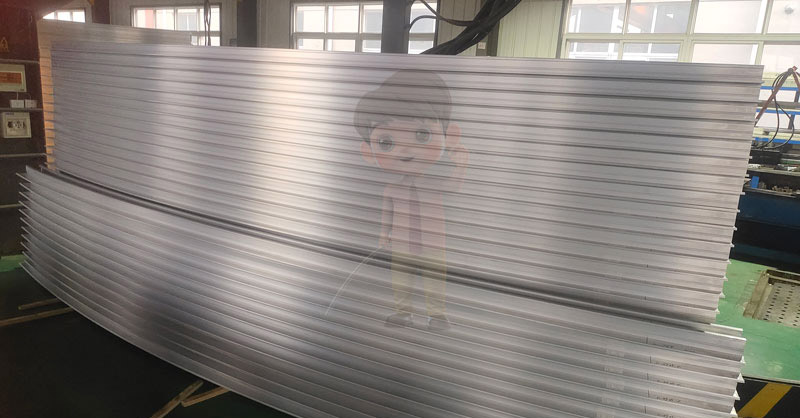
Roll bending is one of the most common methods for forming large aluminum profiles and curved components. In this process, aluminum material passes through a series of rollers that gradually apply pressure to create the desired curve.
This method is suitable for producing large-radius bends and continuous curved structures. It is widely used in architectural projects, transportation systems, and industrial frameworks.
Advantages of roll bending include:
Suitable for large and long aluminum profiles
Provides smooth and continuous curves
Reduces material waste
Supports high-volume production
2. Stretch Bending
Stretch bending is an advanced forming technique where aluminum is stretched while being bent around a customized die. The combination of tension and bending force helps maintain the original cross-sectional shape of the aluminum profile.
This technology is particularly useful for applications requiring high precision and excellent surface quality.
Common applications include:
Aircraft components
Automotive structural parts
Aluminum curtain walls
High-end architectural designs
3. Press Brake Bending
Press brake bending uses a machine tool to apply force through a punch and die system, creating specific angles in aluminum sheets or plates.
This method is widely used for manufacturing:
Aluminum panels
Machine housings
Industrial enclosures
Fabricated metal parts
Press brake bending provides flexibility because different dies can be used to achieve various shapes and angles.
4. CNC Aluminum Bending
With the development of digital manufacturing, CNC bending technology has become increasingly popular. Computer-controlled systems allow manufacturers to achieve accurate and repeatable bending results.
CNC aluminum bending offers:
High dimensional accuracy
Reduced human error
Efficient production management
Complex shape capabilities
It is especially suitable for industries requiring strict quality standards.
Applications of Aluminum Bending
1. Architectural Industry
The architectural sector is one of the largest users of aluminum bending technology. Modern buildings often feature curved facades, aluminum curtain walls, decorative structures, and unique design elements that require precisely bent aluminum profiles.
Aluminum bending allows architects to create innovative shapes while maintaining lightweight structures and long-term durability.
Typical applications include:
Curved window frames
Aluminum curtain walls
Stadium structures
Exhibition halls
Commercial building decorations
2. Automotive Industry
The automotive industry increasingly relies on aluminum components to reduce vehicle weight and improve fuel efficiency. Bent aluminum parts are used in vehicle frames, body structures, and interior components.
Benefits include:
Reduced vehicle weight
Improved energy efficiency
Enhanced structural performance
Better design flexibility
As electric vehicles continue to grow, aluminum bending technology is expected to become even more important.
3. Aerospace Industry
Aerospace manufacturing requires materials that are lightweight yet strong. Aluminum alloys are widely used in aircraft structures because of their excellent strength-to-weight ratio.
Precision aluminum bending helps produce components such as:
Aircraft frames
Structural supports
Interior systems
Specialized aerospace parts
Strict quality control and advanced bending techniques ensure reliability in demanding aerospace environments.
4. Transportation and Rail Systems
Rail vehicles and transportation infrastructure require durable and lightweight materials. Bent aluminum profiles are commonly used in train bodies, station structures, and supporting frameworks.
The advantages of aluminum bending include corrosion resistance, reduced maintenance requirements, and improved service life.
5. Industrial Equipment Manufacturing
Many industrial machines and equipment use aluminum bent components because they provide strength while keeping overall weight low.
Applications include:
Automation equipment
Mechanical frames
Protective covers
Conveyor systems
Specialized machinery
Advantages of Aluminum Bending Technology
1. Lightweight and High Strength
One of the greatest advantages of aluminum bending is the ability to create lightweight structures without sacrificing strength. This makes aluminum an ideal material for industries where weight reduction is important.
2. Improved Product Appearance
Bending creates smooth curves and seamless designs that are difficult to achieve through traditional fabrication methods. This improves both functional performance and visual appeal.
3. Reduced Material Waste
Compared with processes involving multiple cutting and welding steps, aluminum bending can reduce material consumption and simplify production.
4. Enhanced Structural Integrity
Bent aluminum components often have fewer joints and connections, which can improve overall strength and reliability.
5. Environmentally Friendly Manufacturing
Aluminum is highly recyclable, and efficient bending processes help reduce waste. This supports sustainable manufacturing goals and green production practices.
Factors Affecting Aluminum Bending Quality
Several factors influence the final quality of aluminum bending:
Material Selection
Different aluminum alloys have different levels of flexibility and strength. Choosing the correct alloy is essential for successful bending.
Bending Radius
The bending radius must match the material characteristics. Too small a radius may cause cracking, while an excessively large radius may affect design requirements.
Equipment Accuracy
High-quality bending machines and precision control systems are necessary to achieve consistent results.
Surface Protection
Aluminum surfaces can be sensitive to scratches and marks during processing. Proper tooling and protective measures help maintain appearance quality.
Future Development Trends of Aluminum Bending
The future of aluminum bending technology will focus on automation, digitalization, and intelligent manufacturing.
Advanced CNC systems, robotic production lines, and simulation software will allow manufacturers to optimize bending processes before actual production. This will reduce costs, improve efficiency, and support more complex designs.
At the same time, growing demand for electric vehicles, green buildings, and lightweight transportation solutions will continue to drive innovation in aluminum bending technology.
Aluminum bending technology is a critical manufacturing process that combines precision engineering, material efficiency, and design flexibility. Through advanced bending methods such as roll bending, stretch bending, press brake bending, and CNC forming, manufacturers can produce high-quality aluminum components for a wide range of industries.
From architecture and automotive manufacturing to aerospace and industrial equipment, aluminum bending provides significant advantages in strength, appearance, efficiency, and sustainability. As industries continue to pursue lightweight and environmentally friendly solutions, aluminum bending technology will remain an important part of modern manufacturing development.
 LIST
LIST01
2026-08
Number of visitors:1
HOT NEWS
-
Custom Aluminum Profile Stretch Bending Solutions
2026-09-01
-
Professional Metal Bending for Custom Fabrication Projects
2026-08-17
-
Aluminum Bending Technology: Processes, Applications, and Industry Advantages
2026-08-01
-
Window and Door Profile Bending Services: Precision Curved Aluminum Solutions for Modern Architecture
2026-07-17