



 English
 Chinese
 Japan
Japan German
News

Choosing a Reliable Profile Bending Company: Important Factors to Consider
In modern construction, industrial manufacturing, automotive production, and architectural engineering, profile bending plays an increasingly important role. From curved steel structures and aluminum frames to custom metal components used in large-scale infrastructure projects, profile bending technology allows manufacturers to create precise curved shapes while maintaining structural strength and material integrity.
However, the final quality of a bending project depends heavily on the company performing the work. Choosing the right profile bending company is not simply about finding the lowest price. It involves evaluating technical capabilities, equipment quality, production experience, customer service, and long-term reliability. For businesses investing in metal fabrication projects, selecting a dependable partner can significantly affect product quality, project timelines, and overall costs.
One of the first things to evaluate when choosing a profile bending company is industry experience. A company with years of hands-on experience is usually better prepared to handle complex bending requirements and unexpected production challenges.
Different industries require different bending standards. For example, architectural projects often prioritize aesthetics and precision, while industrial applications may focus more on structural durability and load-bearing performance. A company that understands these differences can provide more suitable solutions based on the customer’s actual needs.
Experienced profile bending companies are also more likely to have worked with various materials such as stainless steel, aluminum, carbon steel, copper, and specialized alloys. Since each material behaves differently during the bending process, technical knowledge becomes extremely important in avoiding cracks, deformation, or surface damage.
In many cases, experienced manufacturers can also provide practical recommendations during the design phase, helping clients improve manufacturability and reduce unnecessary production costs.
The quality of profile bending depends greatly on the machinery and technology being used. Modern bending equipment allows for higher precision, tighter tolerances, and more consistent results, especially in projects requiring complex curved shapes or large production volumes.
Reliable profile bending companies usually invest in advanced CNC bending machines, section bending equipment, roller bending systems, and digital measurement tools. These technologies help ensure that each component meets exact project specifications.
Older or outdated equipment may struggle to maintain consistent curvature, especially when working with thick materials or complicated profiles. This can lead to inaccuracies, wasted materials, and project delays.
Automation and digital control systems also improve production efficiency. Faster setup times, reduced manual adjustments, and accurate repeatability are especially important for large commercial or industrial orders where consistency is critical.
When evaluating a supplier, it is often helpful to ask about their equipment capabilities, bending capacity ranges, supported material sizes, and quality control procedures.
Not all profile bending companies offer the same level of technical capability. Some specialize in simple bending projects, while others can handle highly customized or complex fabrication requirements.
A reliable company should be able to process a wide range of profile shapes, including tubes, pipes, angles, channels, beams, flat bars, and custom extrusions. They should also understand how to minimize distortion and maintain cross-sectional integrity during bending.
For projects involving tight radii or unusual geometries, technical expertise becomes even more important. Improper bending techniques can weaken the material or negatively affect final assembly performance.
In addition, professional companies usually provide engineering support, CAD drawings, prototype development, and technical consultation. These services can help clients identify potential design issues before production begins, reducing risks and improving overall project outcomes.
Quality control is one of the most important indicators of a trustworthy profile bending company. Even small bending inaccuracies can create major problems during installation or assembly, especially in architectural structures or industrial systems where precision is essential.
Reliable manufacturers typically implement strict inspection procedures throughout the production process. This may include dimensional measurements, curvature verification, surface inspections, and material testing.
Many professional companies also follow international quality management standards such as ISO certifications. While certification alone does not guarantee perfect results, it often reflects a company’s commitment to standardized production and quality assurance practices.
Consistency is especially important for projects requiring multiple identical components. Poor quality control can result in mismatched parts, additional labor costs, and expensive project delays.
Before placing a large order, many customers request sample parts or prototype testing to verify the company’s production quality and bending accuracy.
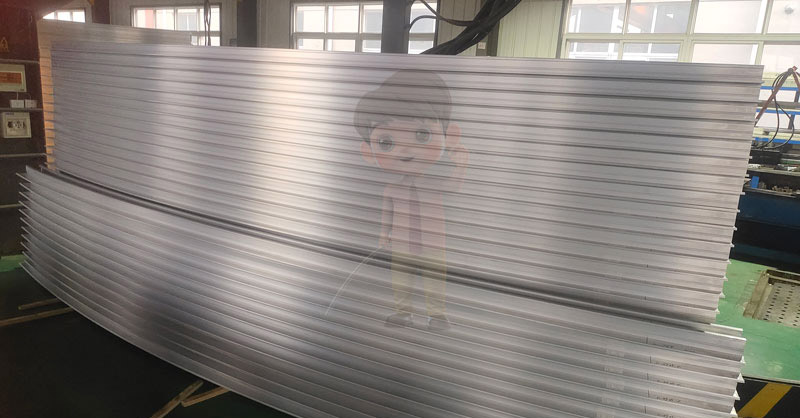
Production capacity is another key factor when choosing a profile bending supplier. Some projects require only a few custom components, while others involve large-scale manufacturing with strict deadlines.
A reliable company should have sufficient manpower, equipment, and workflow management systems to meet project schedules without compromising quality.
Delayed delivery can affect entire construction or manufacturing timelines, leading to increased costs and operational disruptions. Therefore, it is important to evaluate whether the supplier has a proven record of delivering orders on time.
Communication also plays a major role in project management. Professional profile bending companies usually maintain clear communication regarding lead times, production progress, and potential delays. Transparent communication helps customers plan more effectively and avoid unnecessary uncertainty.
Modern engineering and architectural projects often require customized bending solutions rather than standard products. Because of this, flexibility has become a major advantage in the profile bending industry.
Reliable companies should be capable of handling custom dimensions, special materials, unique bending angles, and complex geometries. They should also be willing to collaborate closely with clients during the design and manufacturing process.
Some advanced profile bending companies even offer integrated fabrication services such as cutting, welding, assembly, surface finishing, and installation support. Working with a single supplier for multiple processes can improve efficiency and simplify project coordination.
Customization capability is especially valuable in industries such as architecture, transportation, furniture manufacturing, energy infrastructure, and heavy equipment production.
A company’s reputation often reflects its long-term reliability. Customer reviews, project portfolios, industry references, and repeat clients can provide valuable insight into the company’s professionalism and service quality.
Reliable profile bending companies usually prioritize long-term partnerships rather than one-time transactions. They focus on customer satisfaction, technical support, and problem-solving throughout the project lifecycle.
Responsive customer service is particularly important when dealing with technical modifications, urgent schedule changes, or post-production support. Poor communication can quickly create misunderstandings and delays.
It is often beneficial to work with companies that are transparent about pricing, production limitations, and realistic delivery expectations instead of making exaggerated promises.
While pricing is always an important consideration, choosing a profile bending company based solely on the lowest quote can create long-term problems. Extremely low prices sometimes indicate inferior materials, outdated equipment, limited quality control, or lack of technical expertise.
A slightly higher initial investment in a reliable manufacturer may actually reduce overall costs by minimizing defects, rework, delays, and maintenance issues.
The best approach is to evaluate overall value rather than focusing only on price. Factors such as production quality, technical support, delivery reliability, and long-term durability often have a much greater impact on project success.
Choosing a reliable profile bending company requires careful evaluation of multiple factors, including industry experience, technical capability, equipment quality, customization options, quality control systems, and customer support.
As profile bending becomes increasingly important in modern manufacturing and construction, businesses need dependable fabrication partners that can deliver precise, consistent, and high-quality results.
A professional profile bending company not only provides bending services but also contributes valuable technical expertise, production efficiency, and long-term project reliability. By taking the time to evaluate suppliers carefully, companies can reduce risks, improve project outcomes, and build stronger foundations for future growth.
 LIST
LIST