



 English
 Chinese
 Japan
Japan German
News

Custom Aluminum Profile Stretch Bending Solutions
Custom aluminum profile stretch bending is an advanced metal forming process designed to create smooth, accurate curves in extruded aluminum profiles. Compared with conventional bending methods, stretch bending can significantly reduce deformation, wrinkling, and springback while maintaining the original cross-sectional shape of the profile.
For industries that require complex curved aluminum components, professional stretch bending solutions provide an efficient way to achieve both high dimensional accuracy and excellent surface quality.
What Is Aluminum Profile Stretch Bending?
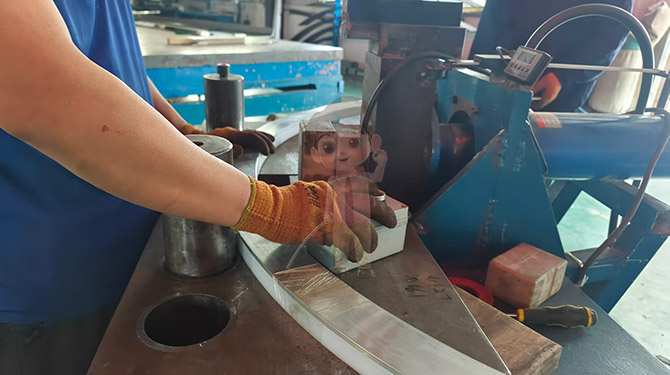
Aluminum profile stretch bending is a forming process in which an aluminum extrusion is securely clamped at both ends, placed under controlled tension, and gradually formed around a bending die. The combination of stretching and bending helps the material maintain a stable shape during the forming process.
This technique is particularly suitable for long and complex aluminum profiles that need large-radius or three-dimensional curves. It is widely used when traditional roll bending or press bending cannot provide the required accuracy or appearance.
Customized Bending for Different Aluminum Profiles
Every aluminum profile has different dimensions, wall thicknesses, alloys, and cross-sectional designs. As a result, stretch bending parameters must be carefully adjusted according to the specific profile and application.
Our custom aluminum profile stretch bending solutions can accommodate a wide range of extruded profiles, including:
Aluminum architectural profiles
Industrial aluminum extrusions
Automotive aluminum profiles
Rail and transportation profiles
Lighting and display profiles
Curtain wall and facade profiles
Decorative aluminum sections
Special-shaped and complex extrusions
Based on the customer's drawings, samples, or technical requirements, the bending process can be developed to achieve the required radius, angle, length, and overall geometry.
Precision and Consistent Results
Dimensional accuracy is one of the most important considerations in profile bending. Improper forming can result in excessive springback, cross-section distortion, surface marks, or dimensional deviations.
A controlled stretch bending process helps improve consistency by applying uniform tension throughout the forming operation. This allows the profile to follow the bending die more accurately and reduces unwanted deformation.
For precision applications, process parameters such as bending radius, stretching force, material properties, die design, and springback compensation can be carefully evaluated before production.
Maintaining Surface Quality
For visible aluminum components, appearance is just as important as dimensional accuracy. Scratches, dents, wrinkles, or excessive surface deformation can affect the final product quality.
During custom stretch bending, appropriate tooling, clamping methods, protective measures, and process control can help minimize surface damage. This is especially important for profiles that will be anodized, powder coated, painted, or used directly in architectural applications.
The goal is to produce smoothly curved profiles with a clean and uniform appearance while preserving the integrity of the extrusion surface.
From Prototype to Mass Production
Custom aluminum profile stretch bending services can support projects at different production stages. For new products, prototype bending allows engineers to verify the required radius, shape, and installation dimensions before moving into larger-scale production.
Once the bending parameters and tooling have been confirmed, the process can be standardized for repeat orders. This helps maintain consistent quality across different production batches and reduces unnecessary setup and adjustment time.
Whether you require a small quantity of customized curved profiles or a large-volume production run, a well-developed stretch bending process can provide an efficient manufacturing solution.
Applications of Curved Aluminum Profiles
Stretch-bent aluminum profiles are used in many industries where curved structures combine functionality with modern design.
In the automotive industry, curved aluminum profiles can be used for body structures, trim components, frames, and other lightweight structural parts.
In architecture and construction, stretch-bent profiles are commonly used for curved curtain walls, facades, windows, doors, railings, and decorative structures.
In the transportation sector, aluminum profiles can be formed into curved components for railway vehicles, buses, marine equipment, and other lightweight transportation systems.
The process is also suitable for industrial equipment, lighting systems, furniture, exhibition structures, and customized engineering projects.
Why Choose Custom Stretch Bending?
Compaed with standard bending processes, aluminum profile stretch bending offers several advantages:
Excellent control of profile deformation
Reduced springback
Smooth and consistent curved surfaces
Improved dimensional accuracy
Suitable for large-radius bends
Ability to process complex extrusion shapes
Better suitability for visible architectural profiles
Consistent results for repeat production
By combining suitable tooling with carefully controlled forming parameters, manufacturers can produce curved aluminum profiles that meet demanding design and engineering requirements.
Successful aluminum profile bending begins with understanding the material, profile geometry, and final application. Important information such as aluminum alloy, profile dimensions, wall thickness, bending radius, overall length, and required tolerances can be used to develop the appropriate forming process.
Whether you have a standard extrusion that needs to be curved or a complex custom profile requiring a specialized forming solution, professional engineering support can help determine the most suitable approach.
From drawing review and process development to prototype production and final manufacturing, custom aluminum profile stretch bending provides a practical solution for producing accurate and visually appealing curved aluminum components.
 LIST
LIST01
2026-09
Number of visitors:1
HOT NEWS
-
Custom Metal Bending Solutions for Industrial Manufacturing
2026-10-14
-
Aluminum Bending Services | Professional Aluminum Profile Bending Solutions
2026-09-30
-
Tensile Bending Explained: How Precision Shapes Complex Metal Profiles
2026-09-16
-
Custom Aluminum Profile Stretch Bending Solutions
2026-09-01